|
|
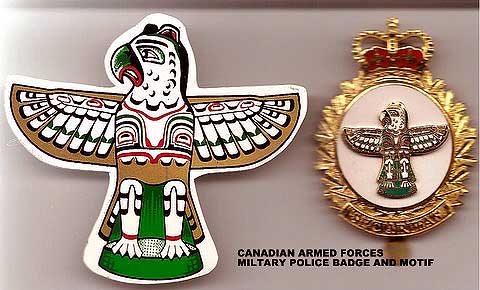
History Of The Military Police * * * Thunderbird Badge * * * |
|
| - Jointly Submitted By - | |
 Major (Retired) Bill Stoker Former Member of the Canadian Provost Corps And CF Security Branch And Member Of The Thunderbird Badge Project Committee (1967) |
 Chief Warrant Officer (Retired) George Powell Former Member of the Canadian Provost Corps And Branch Chief Warrant Officer, CF Security Branch, |
|
Forward  With the formation of a unified Branch, The Canadian Forces Security And Intelligence Branch, came a need to replace the badge of the Canadian
Provost Corps , including the service badges of the Navy and the Air Force and the use of the Indian Totemic Thunderbird as the symbol for the
Security Branch arose out of the recommendations of the Insignia Steering Group appointed by Director General Of Intelligence (DGI) on 15 May
1967.
The Piquet Report from a study group which included Royal Canadian Air Force (RCAF) Service Police Officer, Major R Digeur, proposed
that the Intelligence and Military Police services of the newly unified, Canadian Armed Forces (CAF), be combined into one branch under the title of
Security Services and be placed under the responsibility of the Director General Of Intelligence And Security (DGIS).
In 1967, while seconded to the DGIS Branch, Major (retired) William (Bill) Stoker was delegated to receive submissions for a badge/emblem
for the newly amalgamated security services. With the collaboration of Canadian Intelligence Corps (C Int C) Major D. Wiens, the Thunderbird,
along with the supporting criteria, was submitted for the Selection Committee's consideration. A comprehensive presentation subsequently led to
the Thunderbird's acceptance. The wreath which encircles the badge was added by a Canadian Forces Headquarters (CFHQ) heraldic artist. |
The following details are based on the original unclassified documentation prepared by DGIS, explaining the significance of the new Thunderbird
Hat Badge to be worn by members of the CF Security Branch, which also encompasses the legend of the Thunderbird, believed to be one of the most
common emblems of the Northwest Coast Indian Tribes of British Columbia and is often the crowning figure on craved totem poles before a Chief's house.
In April 1972, Her Majesty the Queen graciously approved the Badge for the Security Branch of the Canadian Forces.
The Badge is an adaptation of the mythical thunderbird and from that design has involved all insignia, badges and symbols of the Security Branch (renamed
The Military Police Branch in 2007). Follwing several years of planning and research by Major William (Bill) Stoker - the Thunderbird Badge was approved
by The Queen. The Thunderbird Badge is officially identified as follows:
|
|
The heraldic significance, although relatively straightforward, merits some elaboration. Of significance is the fact that the face depicted on the chest
of the bird, symbolizes the bird's ability to transform itself into human or any other form; for our purposes the face alludes to the dual role assigned to the
Security Branch and is meant to symbolize both the overt and the covert operations.
|
|
The Motto - Securitas - is a latin word meaning peace of mind, making sure and securing. The latter meaning is acepted as the intent of the
Motto.
|
|
The Thunderbird is generally accepted as an honourable bird, a good spirit, one dedicated to helping man. In the mythical world of ancient Indian lore it
was never identified as a doer of evil or a bearer of treachery with malice. We can rightfully wear the Thunderbird with pride; If we do not dishonour the
Thunderbird, it will never dishonour us!
|
|
- The End -
|
|
|