|
Colonel Anthony J. Scotti, MC, CD 1915 - 1995 |
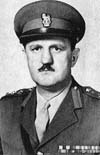
 Colonel Anthony J Scotti, an Honorary Life Member of the Canadian
Provost Corps Association, passed away in hospital in Gainsville,
Florida, USA. He was among the few members of the Corps who
served throughout its entire being from inception in 1940 till
unification in 1968. Tony Scotti was a devoted and enthusiastic
supporter of the Association's purpose of fostering and
maintaining the traditions and comradeship of the Canadian
Provost Corps.
Colonel Scotti enlisted in the Canadian Army in 1940 and was assigned to
the newly founded Canadian Provost Corps which was formed in June
of that year to provide Military Police support to the ever
growing Army in Canada and abroad. He was thus a "charter member"
or "Original Provost" of an organization which would serve with
great distinction in the years of war and peace until 1968 when
it, the Corps, was absorbed in the unification of the Canadian
Armed Forces. Tony Scotti contributed in great measure to the
excellence of that portion of the military history of Canada. His
first day in the Corps ( 15 June 1940 ) saw Corporal Tony Scotti
embarked on the Duchess of Athol in mid-Atlantic en route to the
United Kingdom. His final days in the Corps found him in the rank
of Colonel as the penultimate Provost Marshal (Army) (January
1962 - July 1964)
.
He served in Canada and overseas in the rank of Corporal and
Sergeant. In July 1942 he was commissioned and served in many
line and staff appointments in England, Italy and Northwest
Europe. He was awarded the Military Cross a very significant
recognition of his bravery in action (. The Military Cross is a
Decoration for distinguished and meritorious service to "Fighting
Services" in action) . He was also Mentioned in Despatches (MID).
He commanded Number 5 Provost Company in Italy and was
subsequently appointed as the Assistant Provost Marshal (the
senior military police or Provost staff officer / advisor to the
Division Commander ) 5 Canadian Armoured Division. His linguistic
abilities were of inestimable value in these wartime assignments
and would continue to be so in his post-war career
assignments.
Tony returned to Canada in the rank of Major and was appointed
Assistant Provost Marshal 6 Infantry Division. This was followed
by service as the Deputy Assistant Provost Marshal in Calgary. In
1948 his skills as a staff officer were recognized in his
appointment as the Deputy Assistant Adjutant and Quartermaster
General ( the senior staff officer / advisor to the Camp
Commander for all logistic and administrative matters and the
direction of the staff assigned to the formation for those
purposes) at Headquarters Camp Borden. This Army Base was the
corner stone of the rebuilding of a post war Canadian Army and
housed many of the Arms and Services training centres and
schools. The significance of Tony's appointment to this senior
staff appointment is thus readily apparent.
This was followed by his first tour on the staff of General Gruenther
at Supreme Headquarters Allied Powers Europe (SHAPE) . ( Tony
subsequently filled a second tour at SHAPE in late 1964 as a
Colonel in the Logistics Branch) He returned to Canada in August
1955 to assume the appointment of Deputy Provost Marshal in the
rank of Lieutenant Colonel at Army Headquarters in Ottawa.
In January 1960 Tony was appointed as the Commandant of the Canadian
Provost Corps School in Camp Shilo Manitoba. Shortly after this
appointment a decision was taken to relocate the School to Camp
Borden and in the summer of that year he directed that successful
undertaking. He immediately developed a vision for the School at
its new site in Borden and led his staff in its attainment as an
effective and efficient training centre in this new location.
At the present Canadian Forces Military Police Academy, the successor to
the Canadian Provost School has, among many rooms dedicated to
the leaders of our Corps, has a room named the Anthony J. Scotti
Classroom. This classroom is dedicated to the training of
Military Police in the use of computers. It is totally
appropriate to dedicate this room to Tony's memory. The reason
for this is his leadership and drive in having typing training
included in the Military Police training, when the C Pro C School
moved from Camp Shilo to Camp Borden in 1960. It was a wise and
long overdue training issue which he championed then and
initially saw its fulfillment at the Royal Canadian Army Service
Corps School. The computer has replaced the typewriter both as an
indispensable means of communicating and analysis in the Military
Police arsenal of skills. Tony's wisdom in ensuring that
key boarding was a requirement in MP training remains
unchallenged. It is thus totally appropriate that the site of
this training is the Anthony J. Scotti Classroom.
Tony was promoted to the rank of Colonel in January 1962 and appointed
Provost Marshal (Army) at Army Headquarters in Ottawa. This
appointment to be the Corps Director of an organization he had
joined 22 years earlier as a private soldier is testament to his
skills as a leader and a fine human being respected by both his
subordinate and senior military colleagues alike.
Colonel Anthony J Scotti, an Honorary Life Member of the Canadian
Provost Corps Association, passed away in hospital in Gainsville,
Florida, USA. He was among the few members of the Corps who
served throughout its entire being from inception in 1940 till
unification in 1968. Tony Scotti was a devoted and enthusiastic
supporter of the Association's purpose of fostering and
maintaining the traditions and comradeship of the Canadian
Provost Corps.
Colonel Scotti enlisted in the Canadian Army in 1940 and was assigned to
the newly founded Canadian Provost Corps which was formed in June
of that year to provide Military Police support to the ever
growing Army in Canada and abroad. He was thus a "charter member"
or "Original Provost" of an organization which would serve with
great distinction in the years of war and peace until 1968 when
it, the Corps, was absorbed in the unification of the Canadian
Armed Forces. Tony Scotti contributed in great measure to the
excellence of that portion of the military history of Canada. His
first day in the Corps ( 15 June 1940 ) saw Corporal Tony Scotti
embarked on the Duchess of Athol in mid-Atlantic en route to the
United Kingdom. His final days in the Corps found him in the rank
of Colonel as the penultimate Provost Marshal (Army) (January
1962 - July 1964)
.
He served in Canada and overseas in the rank of Corporal and
Sergeant. In July 1942 he was commissioned and served in many
line and staff appointments in England, Italy and Northwest
Europe. He was awarded the Military Cross a very significant
recognition of his bravery in action (. The Military Cross is a
Decoration for distinguished and meritorious service to "Fighting
Services" in action) . He was also Mentioned in Despatches (MID).
He commanded Number 5 Provost Company in Italy and was
subsequently appointed as the Assistant Provost Marshal (the
senior military police or Provost staff officer / advisor to the
Division Commander ) 5 Canadian Armoured Division. His linguistic
abilities were of inestimable value in these wartime assignments
and would continue to be so in his post-war career
assignments.
Tony returned to Canada in the rank of Major and was appointed
Assistant Provost Marshal 6 Infantry Division. This was followed
by service as the Deputy Assistant Provost Marshal in Calgary. In
1948 his skills as a staff officer were recognized in his
appointment as the Deputy Assistant Adjutant and Quartermaster
General ( the senior staff officer / advisor to the Camp
Commander for all logistic and administrative matters and the
direction of the staff assigned to the formation for those
purposes) at Headquarters Camp Borden. This Army Base was the
corner stone of the rebuilding of a post war Canadian Army and
housed many of the Arms and Services training centres and
schools. The significance of Tony's appointment to this senior
staff appointment is thus readily apparent.
This was followed by his first tour on the staff of General Gruenther
at Supreme Headquarters Allied Powers Europe (SHAPE) . ( Tony
subsequently filled a second tour at SHAPE in late 1964 as a
Colonel in the Logistics Branch) He returned to Canada in August
1955 to assume the appointment of Deputy Provost Marshal in the
rank of Lieutenant Colonel at Army Headquarters in Ottawa.
In January 1960 Tony was appointed as the Commandant of the Canadian
Provost Corps School in Camp Shilo Manitoba. Shortly after this
appointment a decision was taken to relocate the School to Camp
Borden and in the summer of that year he directed that successful
undertaking. He immediately developed a vision for the School at
its new site in Borden and led his staff in its attainment as an
effective and efficient training centre in this new location.
At the present Canadian Forces Military Police Academy, the successor to
the Canadian Provost School has, among many rooms dedicated to
the leaders of our Corps, has a room named the Anthony J. Scotti
Classroom. This classroom is dedicated to the training of
Military Police in the use of computers. It is totally
appropriate to dedicate this room to Tony's memory. The reason
for this is his leadership and drive in having typing training
included in the Military Police training, when the C Pro C School
moved from Camp Shilo to Camp Borden in 1960. It was a wise and
long overdue training issue which he championed then and
initially saw its fulfillment at the Royal Canadian Army Service
Corps School. The computer has replaced the typewriter both as an
indispensable means of communicating and analysis in the Military
Police arsenal of skills. Tony's wisdom in ensuring that
key boarding was a requirement in MP training remains
unchallenged. It is thus totally appropriate that the site of
this training is the Anthony J. Scotti Classroom.
Tony was promoted to the rank of Colonel in January 1962 and appointed
Provost Marshal (Army) at Army Headquarters in Ottawa. This
appointment to be the Corps Director of an organization he had
joined 22 years earlier as a private soldier is testament to his
skills as a leader and a fine human being respected by both his
subordinate and senior military colleagues alike.
BEGINNING THE RESURRECTION
One of the significant events in the post-war development of the
Canadian Provost Corps and in effect its "resurrection" was the
first Provost Marshal's Conference held at Camp Borden in 16 - 19
March 1949. Under the Chairmanship of the Provost Marshal (Army),
Lieutenant Colonel James R Stewart, nine officers of wide
experience in the Corps met to discuss a wide range of subjects
including establishments, specific units, training, mobilization
planning , channels of communication , wearing of sidearms, Corps
accouterments and many other concerns essential to the long term
development of high standards of performance and service. This
conference " was also notable for the introduction of two other
important features of Corps tradition , namely, a Corps March and
a Corps Motto" ( "Through Night to Light" and Discipline by
Example respectively).
Major Tony Scotti was among this group of nine "Wise Men" of the
Canadian Provost Corps who set the course for the Corps at this
important meeting. He went from this genesis of a peacetime
Canadian Provost Corps to both participate in and lead the
implementation of the many significant decisions which led to the
distinguished reputation of the Corps and its many
members.
Tony's participation and input to this "Resurrection" is one of his most
significant contributions to Canada and the Canadian
Army.
PRE AND POST MILITARY SERVICE
Tony was born at Shawinigan Falls, Quebec on 9 April 1915. He attended
and graduated from Thomas D'Arcy McGee High School in
Montreal.
Prior to joining the Army in 1940 Tony was a member of the Westmount,
Quebec Police Department. His colleagues on that Force remember
him as an first rate police officer. They also sing the praises
of his culinary capabilities in the preparation of pasta and many
Italian sauces.
When Tony left the Canadian Forces he joined the staff of the
Government of Quebec and served as a security adviser to Robert
Bourassa, then Prime Minister of Quebec at a time of rising
concerns in that Province. He was deeply involved in the design
and operation of what became known as "the bunker" a location for
the Government of Quebec and its senior advisors in downtown
Quebec City not too distant from the National Assembly Building.
( It is of interest that the security features and the name/ term
"The Bunker" is still used by locals even now in 1995.)
In addition to his Honorary Life Membership in our Association Tony
was a Life Member of the Canadian Society for Industrial Security
and a Retired Member of the Canadian Military Police
Association.
Tony is survived by his wife Mary, a daughter Carol and her husband Larry
R Kohler, a daughter Annamaria and her husband William Mc Carthy,
a brother Sylvio, a sister Estelle, two granddaughters Annika and
Pia and a grandson Adam.
The funeral was held in Montreal on 13 November 1995. A number of
members of the Association were in attendance. A eulogy which
spoke of the great contribution Tony made to the Canadian Army in
general and the Canadian Provost Corps in particular, as well as
reminiscences of their long personal relationship, was delivered
by Colonel Andy Ritchie, the past Colonel Commandant of the
Association.
Prepared by James D (Jim) Lumsden originally for Watchdog in 1995. |
| Click here to return to the previous page. |